About worldbench
What worldbench is, what kind of reasoning it tests, and how every world is judged.
What is worldbench
worldbench is a benchmark for 3D world generation: one natural-language prompt, many models, and one self-contained Three.js file from each. Every world is run in a real browser and graded against a fixed rubric of about two hundred items by a panel of AI judges: an LLM reads the source code, a VLM looks at the running world, agents frame each biome and re-check disputed evidence, and deterministic metrics measure what the pixels actually do. Scores are out of 280 and absolute, so every model on the leaderboard is measured against the description, not against each other.
The worlds are still here to explore. A score tells you how much of the description a model built; walking around the island shows you what it feels like.
What it actually tests
Every model gets the same prompt and has to produce a single self-contained Three.js scene (a floating, multi-biome voxel island) from a text description alone, with no image, no schema, no reference file. Getting that right takes more than scene styling. It forces the model to reason about several different things at once:
- Spatial / relational placement: the prompt encodes a placement graph, not a list. Snow mountains sit behind the snowy conifer forest, which sits beside the highlands, which slope down into a flowering grove; desert and volcano have to stay physically and hydrologically separate. The model has to hold that whole adjacency graph in its head and lay out geometry that satisfies it, not just place ten biomes wherever they fit.
- Ecological causality: water has to behave like water. Mountain melt feeds a wet corridor through the forest, highlands, jungle, and grassland, then widens into a coastal delta. Desert is a rain-shadow basin with no through-river. The volcano sits outside that whole system, and lava touching water is supposed to turn into obsidian. None of this is decorative; it's a small causal system the model has to simulate correctly, not just describe.
- Elevation and scale reasoning: peaks dominate, shelves sit mid-height, plains stay low, and cliffs drop sharply, and every biome still has to read as its own region from a high orbit instead of collapsing into its neighbor.
- Ecological grounding for flora and fauna: cacti belong in the desert, pines in the snow forest, deer at jungle edges and across the grassland. Placing life that actually matches its climate is a grounding task, not decoration.
- Temporal / systems reasoning: a day/night cycle, a seasonal cycle, and cyclic weather (rain, snow, blizzard, sandstorm, ash) that has to stay staggered by biome instead of blanketing the whole island at once.
- UI and interaction logic: a clickable biome legend that flies the camera to each region, plus a live season readout, testing whether the model can wire 3D scene state to on-screen UI, not just render geometry.
- Constrained code generation: everything ships as one self-contained HTML file, no build step, no separate assets, CDN Three.js only. It has to just open in a browser and run.
There's no single correct island, so nothing is scored against a template. Each test checks whether a property of the description holds in the world the model built, however it chose to build it.
How it's judged
Every world goes through the same five tests, 280 points in total. The maximums are fixed, so totals compare directly across models.
- Voxel island (40): is it the thing that was asked for? A cube-built island floating in a void, water resting on solid ground, and no visible rendering bugs.
- Coverage and placement (20): is every biome built, and does each sit next to the right neighbours at the right height?
- Micro-contents (100): does each biome contain what makes it that biome? Cacti on the desert flats, mangroves in the swamp, a glowing crater on the volcano.
- Physics (100): do things look right and move the right way? Rain falls, rivers flow, clouds drift, lava glows.
- Temporal cycles (20): do the day/night cycle and the seasons actually change the world, rather than only a label on screen?
Each world runs in a headless browser with its randomness seeded, so every run builds the same island, and its clock is pinned so time of day and season can be set on demand. From there, several judges work on the same evidence:
- LLM as a judge, over the code. A language model reads the source and has to quote the exact lines that build each item. Every quote is checked word for word against the file, so a judge can't award points for code that isn't there.
- VLM as a judge, over the frames. A vision model looks at captured views of the running world: fixed camera angles, four times of day, four seasons, and close-ups of every biome. A blind pass first confirms each close-up really shows the biome it claims to.
- Agents as judges. A browser agent uses the world's own legend and camera to frame each biome, and when the frames show something the code check missed, a code-search agent goes back through a read-only copy of the source to settle it.
- Measured, not asked. Motion, day/night brightness and seasonal colour are measured from the pixels themselves. "It moves" only counts if consecutive frames actually differ.
Most items are judged twice, once from the code and once from the running world, because each catches the other's mistakes: code can read right and render wrong, and a screenshot can be framed on the wrong region. Every verdict, quote and frame is kept alongside the score, so any result can be traced back to its evidence.
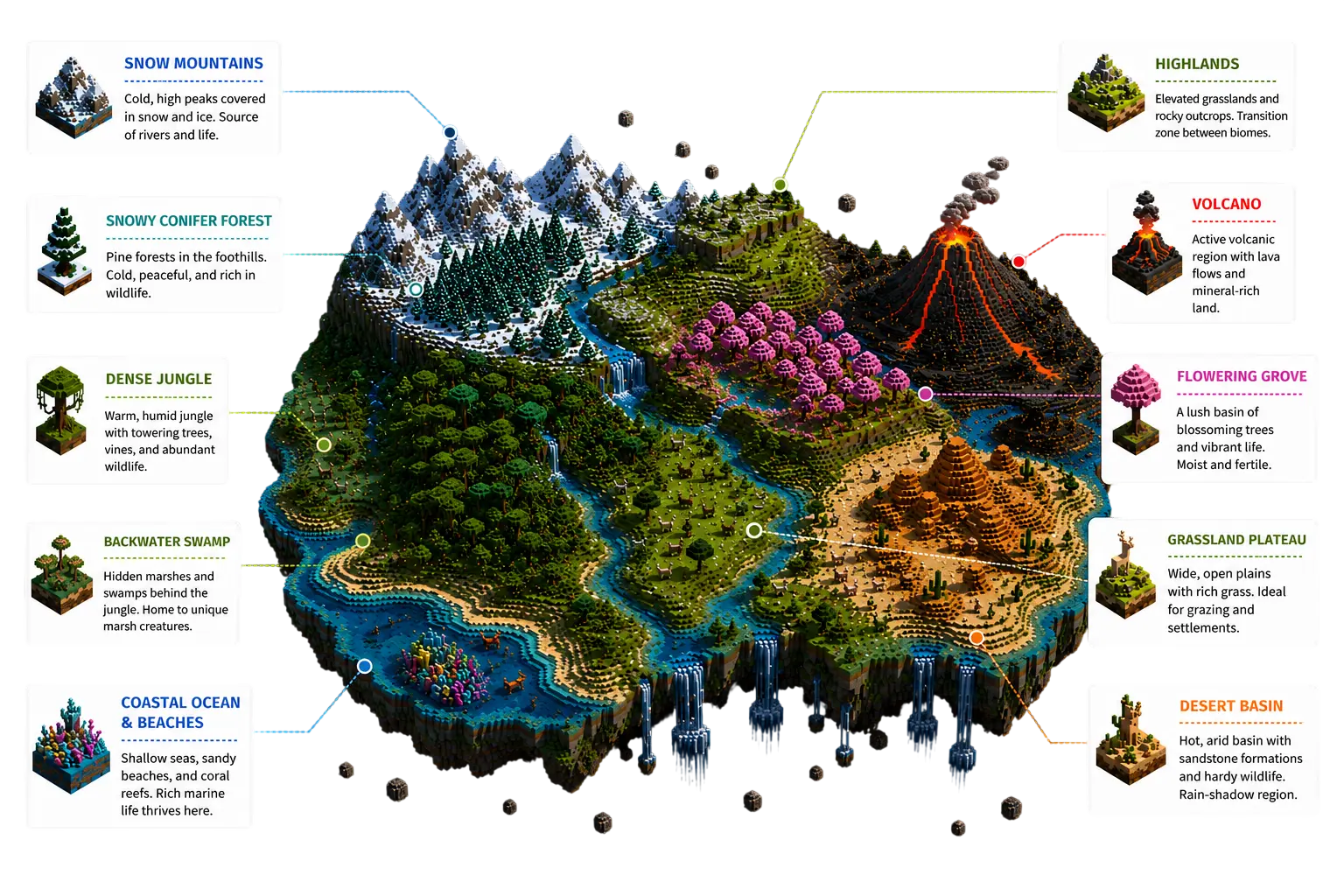
The hand-tuned reference island isn't part of the grading. It's there for people: a picture of what the prompt is reaching for, to compare the generated worlds against by eye.
Reading the island
Every biome from the world description, mapped onto the reference island so it's easy to see what's what while you look through the test results.
The placement graph
This is the prompt's ecology drawn as a graph instead of prose. A biome isn't defined by any single relation, so the edges are typed: the solid teal spine is the one required water corridor — mountain melt feeds the conifer forest, then the highlands, then the jungle, then the grassland plateau, then out to the coastal delta.
The other edges show the relations that aren't that perennial line, each drawn differently on purpose. The flowering grove has two valid sources rather than one — down the highland slope, and/or across from the plains — the dashed teal "and/or" edges, which give the graph its one real cycle (two paths reach the grove). The dotted gold edge to the desert is the subtle one: the desert isn't cut off from nothing, it's linked to the plains only by dry washes that fade out before they arrive — a genuine relation, but never a through-river. The dotted amber edge into the volcano marks the single causal rule that still reaches it: lava touching water quenches to obsidian.
Desert and volcano stay dashed boxes because both are off the perennial water system, and the model has to preserve that — reading the desert's faint dry-wash link without ever routing a real river through it, and leaving the volcano to lava alone.
- Water flow (required corridor)
- Water flow (and/or, optional)
- Dry wash (ephemeral, fades out)
- Causal contact, not a river
Try it yourself
You don't need this site to run the benchmark, just the prompt and a model.
- Open the prompt below and copy it.
- Paste it into any model chat:
Claude,ChatGPT,Gemini, whatever you want to try. - Save the raw output, with no surrounding text, as
world.html. - Open that file in your browser and look around.
Build a single, self-contained HTML file that renders the world described
below as an explorable 3D scene using Three.js (CDN import is fine — no
build step, no separate asset files). It must just open in a browser and
run, with a free camera (e.g. OrbitControls) so a visitor can orbit, zoom,
and pan around the whole world.

Include a simple on-screen UI so a visitor can navigate and read the
world easily (see UI section below).

Output ONLY the complete HTML file — no prose, no commentary, no code fences.

Choose your own overall scale. What matters is relative placement,
ecological causality, and clear visual reading from orbit — not any
particular absolute size or fixed elevation numbers.

────────────────────────────────────────────────────────
THE WORLD
────────────────────────────────────────────────────────

# Floating Biome Island with Ocean — World Description

## Visual style (required)

Minecraft-like voxel / block aesthetic throughout:

-   Terrain, cliffs, water, lava, trees, flora, and structures are built
    from chunky axis-aligned cubes and blocky stacked forms — not smooth
    organic meshes, not photoreal terrain, not low-poly “soft” stylization.
-   Flat, solid face colors (Lambert / unlit-friendly); no PBR gloss, no
    detailed textures required. Pixel-chunk readability from orbit.
-   Trees and plants are stacked blocks / simple voxel silhouettes
    (trunk + canopy cubes), not billboards or smooth cones.
-   Weather and particles can be simple quads or small cubes, but the
    landmass itself must read as a voxel island.

## Overview

A floating landmass hangs motionless in an infinite black void.
Viewed from a high orbit, nearly the entire surface should be readable at
once. Each biome needs room to read as its own region — distinct
transitions, not a muddled cluster. Flora and fauna should feel alive
inside each biome without overcrowding the whole island.

Much of the outer perimeter is bordered by shallow coastal ocean and sandy
beaches before terrain rises inland. Elevations are exaggerated and
dramatic relative to each other: peaks dominate, shelves sit mid-height,
plains are low and open, cliffs drop sharply. The ocean is suspended with
the island and ends at cliff edges where waterfalls plunge into darkness.

## World layout (relationships)

Compose a coherent ecological sequence. Relative placement should feel
like this (adapt freely as long as the relationships hold):

1.  Snow mountains occupy the far / behind end of the island — the final
    alpine massif at the cold edge.
2.  Snowy conifer forest sits as elevated foothills in front of those
    mountains (between the peaks and the rest of the island).
3.  Highlands occupy an elevated plain to the side of the snow forest —
    between the mountain flank and the back side of the flowering grove —
    then slope gently down into that pink grove.
4.  Dense jungle is a large wet canopy region, with a backwater / swamp
    marsh on the jungle's far side (away from the main plains outlet).
5.  Flat grassland plateau is the open river plain that receives wet-
    corridor drainage and leads toward the coast.
6.  Flowering grove is a moist pink basin off the plains / below the
    highland slope — visually separate from green grassland.
7.  Desert is a vast arid basin (south / rain-shadow side) with its own
    sandstone desert mountains — never the volcano.
8.  Volcano is a separate tall cone on volcanic ground only (far from
    the desert's river path).
9.  Coastal ocean and beaches wrap much of the southern and western edge.

## Scale and density (qualitative)

-   Prefer a clearly legible island: biomes spaced so each reads as its
    own region from high orbit.
-   Avoid collapsing adjacent biomes — especially grassland vs flowering
    grove, desert vs volcano, snow forest vs alpine peaks.
-   Within each biome, flora and fauna should feel abundant for that
    climate (dense jungle canopy; cactus across desert flats; pines in
    the snow forest; sparse scrub on highlands).
-   Mountains and the volcano dominate the skyline; desert flats and the
    grassland plateau sit lower between them.

## Fauna

Voxel / blocky animals (stacked cubes, same aesthetic as the land) —
simple silhouettes are enough; place them where they belong:

-   Deer or similar grazers in jungle edges, grasslands, grove, conifers
-   Foxes or small arid / marsh creatures in desert and swamp
-   Occasional coastal or river life near beaches and deltas if it fits
-   Enough motion or presence to feel alive, not empty dioramas —
    without overcrowding

## Ecological reasoning

Layout and systems must follow ecological logic, not decoration:

-   Water stays in the wet corridor: mountain melt → through / past the
    snow-forest foothills and wet highlands → weave through jungle →
    flat grasslands → coastal delta / ocean.
-   Flowering grove is a moist offshoot below the highland slope / plains
    moisture — not a stop on the way into the desert.
-   Desert is arid: vast flat basin with sandstone desert mountains;
    cacti across the flats; only fading dry washes; no through-rivers
    into the volcano; no perennial river cutting the desert core.
-   Volcano is a separate tall cone with lava tributaries and lava pools
    on volcanic ground. Where water meets lava, rock quenches to
    obsidian.
-   Rain falls downward from moving cloud decks over wet biomes.
-   Snowfall comes from cloud decks over the snowy conifer forest.
-   Blizzard / white windstorm lives on the behind face of the snow
    mountains (the far alpine side), not as a front-slope decoration
    facing the forest alone.
-   Snowy trees carry snow on their canopies, not only on the ground.
-   Highlands are genuinely elevated relative to plains and grove, with
    a gentle downslope into the pink forest.

## Biomes

### 1. Snow Mountain Range (far / behind)

-   Tall alpine peaks — high relief, not gentle hills
-   Snow on summits and upper ridges; rock on lower slopes
-   Meltwater feeding the wet corridor
-   Active blizzard on the behind mountain face: fast whitish wind
    sheets (sandstorm motion, white instead of brown), spanning a wide
    strip of that rear alpine tape

### 2. Snowy Conifer Forest (foothills in front of the peaks)

-   Elevated shelf / foothill band in front of the snow mountains
-   Dense pines with snow on canopies as well as ground
-   Cloud deck directly above the forest that drops snowfall onto it
-   Distinct from both bare alpine rock and lowland plains

### 3. Temperate Highlands (elevated plain beside the snow forest)

-   Sit to the side of the snow forest, between mountain influence and
    the back of the flowering grove — an elevated open highland plain
-   Higher than grasslands and grove; rocky hills, scrub, hardy plants
-   Gentle slope down into the pink flowering grove
-   Occasional mist and light rain

### 4. Dense Jungle / Rainforest

-   Thick emerald canopy, layered undergrowth, densely packed trees
-   Rocky clearings, inland ponds, major waterfall
-   On the jungle's backside (away from the plains outlet): a backwater
    / swamp ecosystem — murky standing pools, mangroves or similar,
    low mist, stagnant channels (not a desert river)
-   Persistent jungle rain: rainfall shafts, wet canopy, rising mist
    after showers

### 5. Central Grasslands (flat river plateau)

-   Open flat green plain — clearly not the pink grove
-   Dense winding river network with many tributaries
-   Scattered woodland copses and yellow/white wildflowers
-   Meadow color green/olive, not pink

### 6. Flowering Grove

-   Moist basin receiving the highland downslope and/or plains moisture
-   Dense pink flowering canopy and pink-tinted meadow floor
-   Small streams; visually different from grassland at a glance

### 7. Desert

-   Mostly flat arid land
-   Distinct desert mountains / sandstone peaks on that flat floor —
    these are NOT the volcano
-   Dry washes that fade out; no perennial river through desert core
    or into the volcano
-   Cacti and life spread across the flats
-   Desert winds and sandstorm / dust storm

### 8. Volcanic Wasteland

-   Tall stratovolcano cone with glowing crater — not a flat puddle
-   Lava tributaries into lava pools on volcanic ground only
-   Black basalt, ash plumes, periodic eruptions
-   Water + lava contact becomes obsidian

## Coastal Ocean

Southern and western edges surrounded by turquoise coastal waters:

-   Shallow lagoons and deeper offshore water
-   Rocky shoreline, small islands and reefs
-   Multiple river mouths and a visible braided delta into the ocean
-   Freshwater mixing into saltwater at the mouths

## Beaches

Natural transition from grasslands and forests into beaches:

-   Bright sand, curved bays, warm-region palms where fitting
-   Rocky headlands, clear shallow water, coastal vegetation

## Rivers and Hydrology

A rich branching system that obeys ecological law:

-   Mountain melt and highland moisture feed headwaters.
-   Flow weaves the wet corridor through jungle into the flat grassland
    plateau, then widens into a coastal delta.
-   Grove receives a moist feeder from highland slope and/or plains —
    not a desert route.
-   Desert stays dry aside from fading washes; no river into the volcano.
-   Swamp holds stagnant backwater connected to the jungle wet side.
-   Show the water cycle: rain and melt feed rivers; heat drives
    evaporation mist; moisture returns as rain or snow.

## Climate, Clouds, Seasons, and Sun

-   Rain, snow, mist, sandstorm, ash, and cloud decks arrive in cyclic
    bursts — fade in, hold, fade out, quiet gap — staggered by biome.
-   Snowfall: cloud deck over the conifer foothill forest.
-   Blizzard: whitish high-altitude wind sheets on the behind alpine
    face of the snow mountains.
-   Desert: winds and sandstorm. Volcano: eruptions, ash, lava pools;
    water+lava → obsidian.
-   Reliable seasonal cycle (spring → summer → autumn → winter)
    modulating rain/snow intensity and light tint.
-   Visible square sun on a cyclic day / night pattern: bright noon,
    dimmer dusk and night (the void stays black; the land darkens).

## UI (required for easy navigation)

Keep the HUD minimal and readable over the black void:

-   Biome legend: color swatch + biome name for every major region
    (mountains, snow forest, highlands, jungle, swamp, grasslands,
    flowering grove, desert, volcano, coast / ocean). Optionally note
    each biome's weather flavor (rain, blizzard, sandstorm, etc.).
-   Click (or tap) a legend entry to fly / animate the camera to that
    biome; include a "whole island" overview entry that returns to a
    comfortable high orbit.
-   Season readout: show the current season name on screen and update
    it as the seasonal cycle advances.
-   Brief control hint in the legend footer (e.g. orbit / zoom / pan).

## Cliffs and Underside

-   Vertical rock walls around the perimeter
-   Tall stone foundation matching heightened elevations above
-   Numerous waterfalls; floating rock fragments beneath
-   Blue glowing mineral seams in places

## Color Palette

  Region       Colors
  ------------ -----------------------------
  Ocean        Turquoise, deep blue, cyan
  Beaches      White, cream, tan
  Jungle       Emerald, dark green, mist grey
  Swamp        Murky olive, dark water
  Plains       Green, olive
  Grove        Pink blossoms, soft meadow
  Highlands    Grey-green scrub
  Mountains    White summits, blue-grey rock
  Conifers     Dark pine, snow-capped canopy
  Desert       Gold, ochre, dust haze
  Volcano      Black, orange, crimson, ash
  Rivers       Cyan (murkier in swamp)
  Weather      Rain blue, snow white, sand tan, ash grey

## Lighting

-   Square sun drives a full day → night cycle; seasonal tint modulates
    warmth
-   Nights are clearly darker than noon (ambient + sun intensity drop)
-   Local weather tinting (cooler in storms, ember glow near volcano)
-   Crisp terrain shadows when weather is clear
-   High visibility of the whole island from a comfortable orbit by day
-   Black void background with no stars or atmosphere dome

## Visual Composition

A Minecraft-style voxel floating continent: far snow mountains with a
behind-face blizzard; elevated snow-forest foothills under snowfall
clouds; highlands on an elevated plain sloping into a pink grove; a large
dense jungle with a backwater swamp on its far side; a flat grassland
river plateau; arid desert with its own sandstone mountains separated
from a tall erupting volcano; wet-corridor rivers to a coastal delta;
cyclic weather; square sun with day/night and seasons; clickable biome
legend and season HUD. The ocean borders the land before plunging over
cliff edges into the void.

Success is ecological clarity, vivid living systems, easy navigation,
and a coherent blocky voxel look — invent your own scale; make it as
strong or stronger as this description allows.
Citation
worldbench is described in the paper WorldBench: Evaluating LLMs on Three.js Voxel World Generation (arXiv preprint). If you use the prompt, the outputs or the judge, please cite it:
@article{bakshi2026worldbench,
  title   = {WorldBench: Evaluating LLMs on Three.js Voxel World Generation},
  author  = {Bakshi, Krish},
  journal = {arXiv preprint arXiv:2610.10622},
  year    = {2026}
}Found something interesting?
If a model gives you a genuinely great, or wonderfully broken, result, I'd love to see it. Make a short video, post it wherever you post things, and let me know. This is built and maintained by Krish.